


On the surface, markets appear remarkably resilient, so if you’ve felt a sense of calm looking at your portfolio performance lately, you aren’t alone.
But look beneath the surface and the structural fragility you’ll see in valuations, government debt, and global trade makes holding a narrow, concentrated equity portfolio (including any portfolio largely invested in index ETFs) one of the more dangerous bets an investor can make right now.
Under the banner and theme of American exceptionalism, it’s easy to look at the massive gains in big tech, artificial intelligence (AI), and broad U.S. indices over the past few years and think, “Why own anything else?”
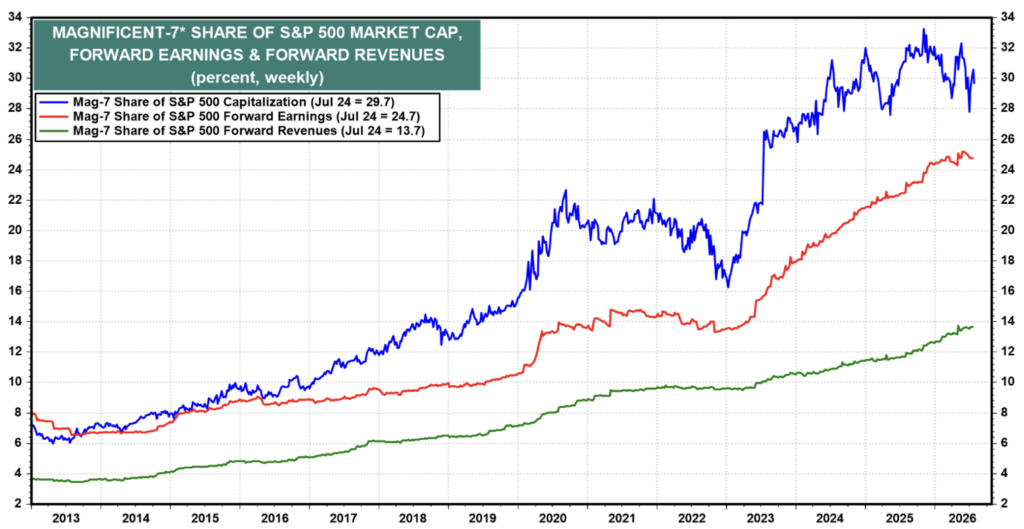
The problem is those index gains have become deceptively narrow. As Figure 1., reveals, a tiny handful of mega-cap companies have been carrying the weight of the entire stock market.
Figure 1. Mag 7 market share
Source: LSEG Datastream and Yardeni Research. Standard & Poor’s and I/B/E/S.
Meanwhile:
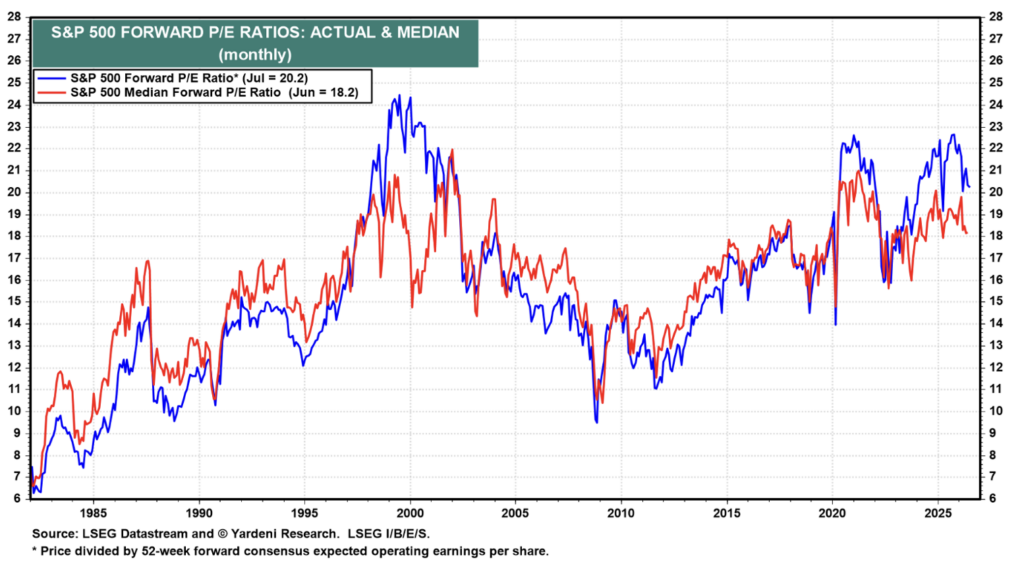
When a portfolio is concentrated in a few high-flying names, you aren’t just betting on tech – you are betting that the macro economy will perform perfectly. If reality chips away at that perfection, concentrated holdings reprice fast.
Figure 2. S&P500 P/E ratio
Source: LSEG Datastream and Yardeni Research. LSEG I/B/E/S.
For thirty years, global corporate profits enjoyed three massive tailwinds: cheap manufacturing in Asia, cheap energy in Europe, and friction-free global trade.
The old regime, particularly in the U.S. was marked by frictionless global trade, ultra-low input costs and low government debt. That regime has been summarily flipped on its head. Today we have Trump-commanded reshoring, geopolitically-inspired supply chain disruption, and the soaring interest servicing costs on US$39 trillion of debt, which is moving many central banks to reduce their demand for U.S. bonds (which the U.S. needs to sell to finance it’s debt) and buy gold.
As countries pull supply chains back home and geopolitical friction rises, production costs go up. At the same time, major governments are running record deficits – the U.S. federal debt alone now incurs interest payments that exceed its total defence budget.
What does this mean for your money?
It means the companies that won the last decade by relying on cheap debt and low-cost global supply chains may not be the companies that win the next one.
When complex systems face stress from multiple directions at once, they may appear to adjust gradually – until they reprice overnight.
I’ve seen it before. Markets drift lower initially until you wake up one morning and the S&P500 has fallen 600 points or over eight per cent from today’s levels.
Historical precedence
The S&P 500 has experienced several single-day drops exceeding 8 per cent:
Of course, it’s not the goal of investing to guess the exact day the market shifts; it’s to build a portfolio that thrives no matter what happens next.
True diversification in today’s environment goes far beyond just buying a basic bond index. It means owning uncorrelated assets that handle different economic weather:
Diversification isn’t about giving up upside. It’s about taking some profits from equities that have done well (and yes paying a little tax), while making sure a single bad shift in sentiment, inflation, or interest rates doesn’t reset your retirement timeline by five years or more.
Concentration risk
If you haven’t adjusted your asset mix recently, recent equity market gains have likely pulled your allocation out of balance – leaving you far more exposed to single-sector risks than you think.
Consider a factor analysis of your portfolio, identify hidden concentration risks, and lay out a strategic plan tailored for the road ahead. There are multiple tools available online to assist you with your portfolio analysis.
For further information please contact David Buckland, Chief Executive Officer, or Rhodri Taylor, Account Manager, on (02) 8046 5000 or investor@montinvest.com.